Showing posts with label essay. Show all posts

Monday, 28 May 2012

Birth of a Nation: The Depiction of War in American Cinema, from D.W. Griffith’s Birth of a Nation to Tarantino’s Inglourious Basterds.


Birth of a Nation: The Depiction of War in American Cinema, from D.W. Griffith’s Birth of a Nation to Tarantino’s Inglourious Basterds.

In 1915 D.W. Griffith’s ‘Birth of a Nation’ caused a rather large stir, mostly for being an adept civil war epic that all of sudden became an uncomfortably racist caricature after the interval for no easily discernible reason, but also for being a technical masterpiece in its own right, establishing many of the conventions that were to define the American war epic for decades to come. There is the story of love rent asunder by war, the epic re-enactments of historic battles, fictionalised accounts of factual events, and men who bravely fight and gallantly die for their country. Whilst these themes were by no means new in 1915, indeed, the tale of love between rivalling factions is undeniably Shakespearean, it was the use of cinema as the medium for these literary themes that made the film so innovative, and as such an important keystone in shaping early American war films.

In defense of his film, Griffith wrote that we must sometimes ’show the dark side of wrong, that we may illuminate the bright side of virtue’, and this sentiment seems to be one that has in some ways affected serious depictions of war in American cinema throughout its history. Schindler’s List depicts the horrors of genocide in order to highlight the bravery of the few, whilst Saving Private Ryan graphically offends the eye in order to highlight nobility in the futility of a suicidal cause; a narrative which could be taken as allegorical of the larger conflict. A group of characters coming to terms with the suicidal necessity of their mission for the sake of fulfilling a larger duty is a theme that has cropped up in many post-WWII movies, and is reflective to some degree of the changing perceptions of conflict, brought about by the horrors and seeming wasteful futility of the two world wars.
American films produced within and concerning the First World War often cannot be trusted as independent artistic portrayals. Britain and France in particular led the charge of propagandist war reels and government sanctioned movies depicting the heroism and jingoism of  dulce et decorum est, etc. etc. but America was by no means above this as it prepared to wade into the fray. In January of 1917 Woodrow Wilson had won the support of the senate with the cry of ‘Peace without victory’, and it was mainly by clever manipulation of propaganda through media such as the cinema that Wilson, only three months later, led his country to war with the public’s jingoist war cries still ringing in the soldiers’ ears. He was, as Roosevelt branded him, part of ‘a nauseous hypocrisy’, but cinema’s role as a tool of propaganda in war time should not be overlooked.

In WWII, for the main part, American war films fell between two extremes of comedies or propaganda. Film by this time in America was firmly established as an industry, an imperfect marriage between art and product, the ‘Hollywood’ Sign, had been constructed and copyrighted, and film companies were eager to reflect the general consensus of the public in order to sell tickets. After the Selective Training and Service Act of 1940 introduced peace-time conscription to the U.S., Hollywood sanctioned war comedies from all of its major studios, notable examples including The Three Stooges’ ‘Boob’s Army’, Laurel & Hardy’s ‘Great Guns’, and Abbott and Costello’s ‘Buck Privates’. America’s ability to poke good-hearted fun at itself most likely stemmed from its isolation from the continent, and there’s an obvious degree of catharsis in the humour. It strikes one as being analogous to The Three Stooges unknowingly dodging enemy bullets and shells as they duck and buckle over with laughter brought on by their own laughing gas attack which, if you’ll forgive the pun, rather back fired.  Comedies made up the bulk of early ’40s war films, and all of this was all well and fine, until December 7th, 1941, when the Japanese military led a surprise assault against Pearl Harbor, and all of a sudden for America the war just didn’t seem as funny anymore.

It is interesting to note that the actual reasons for America’s entry into WWII, and its rather explosive departure, are some of the least cross examined themes within a heavily saturated genre. Michael Bay’s typically loud cacophony of inconsolable noise that was 2001’s ‘Pearl Harbor’ is a good example of America’s attitude to its motives recounted in full technicolor. It is a film that focuses narrowly on one historical event in order to rely on an emotional response to create jingoistic sentiment in the face of horror, never twisting, but selecting the right facts to convey its message in the guise of objective historical accuracy.

At the opposite end of the war, the Paul Newman film ‘Fat Man and Little Boy’ and the lesser known ‘Above and Beyond’ are two of the only mainstream American films that deal with the bombings of Hiroshima and Nagasaki, which they do by not focusing on the event itself at all. ‘Above & Beyond’ stars as its hero Paul Tibbets, the man who dropped the first nuclear bomb, and it is a film that romanticises, tenderises, and humanises the story of Enola Gay’s pilots, whilst somewhat skimming over some of the wider repercussions of the film’s cataclysmic ending. It seems to be cinema’s prerogative to tell of the smaller human interest stories within the larger conflict of war, and within American cinema it is selective propaganda, by choosing what to commission and what to financially back, which highlights that imperfect marriage in film between artistic freedom of expression, and sellable commodities. America was rewriting its own victorious history in 35mm and it was not until America became embroiled in Vietnam that depictions of war in cinema began to change in line with shifting public attitudes.


When America began to deploy troops in Vietnam, Hollywood steadfastly and quite simply refused to fund or produce any films dealing with the conflict, with a few fairly unimportant, patriotic and heavily studio-influenced exceptions. It was only after the Tet Offensive, once operations had peaked, when Britain and France were beginning to seek out humour in war with films like ‘La Grand Vadrouille’ and series like ”Allo ‘Allo’ and ‘Dad’s Army’, whilst anti-war protests were reaching their peak, that America felt ready to begin dissecting their involvement in a conflict which did not on face value appear as clean cut as good versus evil. This time round Laurel & Hardy were not to be seen dusting of their old routine.

In a post-’nam age, the legacy of war leaked out of the war-film genre and left its stain upon the rest of the film industry. Right from Rambo, through Travis Bickle, and Big Lebowski’s Walter Sobchak, the long term mental effects and mindsets of Vietnam on its veterans were being portrayed in more than just the films commonly associated with the war genre. By this time the war film could not be further removed from the conventions of Griffith’s ‘Birth of a Nation’, although then again neither could the wars themselves. New structures were being established. A typical example was the ‘Full Metal Jacket’ model, echoed in more modern films like ‘Jarhead’. A group of boys relentlessly training to become marines, a tough as 3D-tetris drill sergeant, and the inevitable death of one of the group in some futile way. Then the part where the group, now freshly graduated from Marine-101 are suddenly in the middle of the battle-zone, all of a sudden not seeming quite as prepared as they were one fade-out previously. All this followed by the waiting, the establishing of relationships, and then the sudden onset of mass slaughter in all its hellish forms. Interestingly enough this model also applies to the 1930s adaptation of ‘All Quiet on the Western Front’; perhaps these modern war films weren’t as removed as all that.

In the ’90s, the popularity of WWII films saw a resurgence and films concerning Vietnam fell by the way side. It seemed that American cinema wanted a return to a war that it could get its head around, and in doing so it quickly branched off into increasingly fictional and detached retellings of an increasingly distant war. Through the years Nazis had been constructed into their own cinematic institution far removed from their historical namesakes, ranking up there with cinematic institutions like zombies and vampires, which film had claimed for its own. The fantastic ‘Dead Snow’, which is about dead, Nazi zombies in some snow, seems a perfect example of this emerging trend. 

However, to my mind, the greatest example of this is Tarantino’s Inglourious Basterds, which seems allegorical of America’s changing depiction of war. Basterds is pure unadulterated fantasy dressed up in historical costumes, and Tarantino’s thinly veiled analogy of the genre itself. It is not a coincidence that the cataclysmic setting for the burning and slaughter of hordes of Nazis, including Hitler himself, takes place within the confines of a cinema, as the projected visage of the downtrodden Jewish proprietor laughs derisively from the big screen. The cinema is where the victors have taken the revenge never satisfactorily awarded to them, reliving the horrors in grainy black and white, and cathartically portraying violent fantasy in high definition. America’s ambiguous motives behind Hiroshima & Nagasaki, and its messy involvement in Vietnam, seems to have spurred it on into portraying itself as the main belligerents in the war against Hitler, lusting after the halcyon days of a bygone war where, despite the futility, the horror, and the bloodshed, the righteous seemed so much more clearly defined.


Tuesday, 24 May 2011

Did the First World War Fundamentally Change British Society?

Siegfried Sassoon


You smug-faced crowds with kindling eye

Who cheer when soldier lads march by,
Sneak home and pray you'll never know
The hell where youth and laughter go.


  In any essay dealing with a change to society caused by a significant event, care must be taken in appreciating the subjectivity of perceived changes, long term and short term trends surrounding the event, and the difficulties of reaching a satisfactory definition of 'society'. This essay will look at both internal changes to British society in terms of shifting class boundaries through the distribution of economic and political power, and also external changes to a society through its views, self-definition, and the role of empire.

Benjamin Disraeli - The UK's only Prime Minister
to date born into a Jewish family.
  In defining society it is best to judge changes on both an international and a domestic level. On an international level, British society within this period is clearly defined by its empire and its imperial outlook. 

  Disraeli had set out in 1867 to popularise empire and place it at the heart of British politics, and the necessity and maintenance of empire became a ground on which Conservatives and Fabians alike could 'find common cause'. By the 1890s 'intellectual and popular tastes had converged' under the cross-party cross-class issue of national imperialism, and even if this were a mere semblance of unity, in reaching an encompassing external definition of British society, judging any fundamental changes to that society by any fundamental changes within it of its views towards empire is both convenient and apt.

  Imperialism gained a fervent popular tinge after the Abyssinian campaign of 1867 that can be seen bubbling to the surface in public sentiments towards the 1874 Ashanti Campaign, the calls for sharp reprisals towards the Egyptian crisis of 1882, right up to popular support for the Boer War of 1899-1902. And though one should not ignore Pro-Boer groups within British society, one should also not forget the terms useage as a politically tarring slur. Dickens, a highly regarded and publicly popular author of the nineteenth-century, perhaps reflected the growing opinion of society in 1853 when he wrote that a savage was something 'highly desirable to be civilised off the face of the earth', which reflects much of his society's imperialistic outlook.

   However, there is an argument that this imperialistic view of British society underwent a fundamental change after the First World War. Britain's war debts, and inability to reclaim the $11.1m (equivalent) it had lent out to support its allies, knocked international confidence in the gold standard, and Britain was forced off it in 1919. British industry struggled to recover markets lost to rival US and Japanese competitors during the war, causing slumps in industry in the 1920s which were acutely felt by the general society, and the general rise of agitation in India and the dependant territories all equated to an 'atmosphere of failure' which severely knocked British society's self-confidence.

Rudyard Kipling used to sign many of his
books with the Indian religious symbol
'the swastika', leading many people with
no sense of chronology to deride him as
a nazi-sympathiser.
  The reverence of society for military leaders such as Kitchener, 'the victor of Omdurman and the Boer War', who in this sense can be seen to reflect a form of imperialist militarism, was fundamentally changed by the horrors and diabolical leadership of the war; which is reflected in most WW1 poetry post-1917, as in Kipling's epitaph, 'If any question why we died,/Tell them, because our fathers lied.', or Sassoon's ridiculing caricature of 'fierce bold... scarlet majors'.

  The 'atmosphere of failure', coupled with this rejection of the imperialist militarism, which had 'produced the war', suggests that the First World War and its consequences constitute a fundamental change within British society in its outlook, self-confidence, and views towards empire.

  However, the Boer War is commonly cited as representing the accumulative 'final bout of popular imperial fervour', and that the First World War simply finished off society's interest in imperialism would imply that its decline forms a part of a longer-term shift that culminated in the first World War, meaning the roots of this fundamental change would precede the war, and hence not be attributable to it.

  Also, whilst the effectiveness of propaganda upon society is debatable, it is evident that the 'imperialists were propagandizing [sic]' increasingly from c.1890 onwards with the establishment of imperialistically orientated groups such as the Imperial Federation League in 1884,  the League of the Empire in 1901, and the Overseas Club in 1910, amongst others. This imposition of empire survived the war and manifested itself in propaganda in the cinemas and other forms that influenced society, such as the Wembley Exhibition of 1924-5, Empire Day, and the survival of the 'new history and geography' taught in schools which emphasised empire and its heroes. The fact that at the outbreak of the Second World War, Orwell was still arguing that imperialism needed to be separated from nationalism suggests its continued role in society's collective consciousness after 1918.

  Based on this evidence, and looking at British society as being externally defined by its imperialistic outlook pre-1914, one may draw the conclusion that if the First World War did fundamentally change society, it was, in this sense, a temporary change, that was rekindled as Britain recovered and reasserted itself on the international stage. After an 'inevitable period of post-war instability', Britain's empire was again relatively stable by 1922, Britain returned to the Gold Standard in 1925, and, whilst domestic markets still suffered, Britain's international position with regards to empire was perhaps stable enough again for its society to revert back to its pre-1914 imperial self-identity.

  However, if there is something to be said for the First World War's long term effect upon this element of British society, it would be that perhaps by 1920s, with inter-war depression taking its hold, society now realised that Britain was dependent on its empire for resources and man-power in order to avoid absolute dependence on the growing power of the USA. The fundamental change is evident in the shift of perceptions towards empire as an indispensable crutch, which would explain the government's increased investment in imperial propaganda, as increasingly the 'empire and society began to need each other',  and away from Dickens' Orientalist, superior view of the empire needing civilising.

Men Whose Fate is Linked with Coal and Cotton - Kurt Hutton, 1939.
The grandeur of the Empire seems a world away from the unemployment of Wigan. Orwell saw both, and knew which one Britain was on the road to.


  Having looked at the effect of the First World War in changing British society in terms of its international, external definition by attitudes towards empire, the remainder of this essay will examine the effects of the First World War at a domestic and internal level, as defined by society's attitude towards itself, and the distribution of economic and political power between the classes.

  One of the most obvious changes to British society brought about by the First World War was the increased prominence of working and middle class women within industry, and the political and economic leverage that created. When the call for volunteers went up in 1914, the Foreign Office was overwhelmed by the sudden rush to enlist from manual labours, clearly drawn by the promise of a guaranteed wage and a better diet; and at its peak the armed forces contained 'one in three of the entire male labour force'. Initially resistant to conscription, the Liberal government were increasingly pushed towards it initially not by a need for troops, but by a need to introduce some measure with which they could limit the amount of volunteers signing up, whose presence on the western front would produce a deficit in essential industry.

  The answer to this deficit however, lay in women. The amount of women in metal and chemical trades rose from 200,000 in 1914 to 'nearly a million by the Armistice', mostly from the working classes, but with spill overs from the middle classes. This in the long term however, did not cause a redistribution of power or fundamental change; women still did not hold the vote and by 1921 the female work force had virtually seen no net change from its 1911 level.

Photos such as this became popular sights, but in cases such as these the allure was more one of novelty
than of an acceptance of the new role of women in British society. Women over 30 may have won the vote
when the war ended, but it was a further decade until women were granted equal voting rights.


  The First World War had created a temporary fundamental change in the constructs of British society, but it had been purposefully reverted back again at its conclusion, as promised under the Treasury Agreements. However, women now played an increased role in Labour and trade unions, whose position was strengthened by labour shortages, with trade union membership peaking  at 8 million in 1919-20. Whilst trade union membership had been rising since before the war, and promises for electoral reform had been made before August in 1914, it was the war itself that brought about the calls that led to the 1918 reform bill. Whereas before, Conservative politicians had held reservations as to enfranchising the proletariat, they now held no reservations in enfranchising 'our soldier lads', and this sudden influx in the amount of enfranchised males, with the working classes in its broadest definition comprising 80% of the population, Labour now firmly established itself in Opposition.

Ramsay Macdonald - Britain's first Labour PM, though not for very
long first time round.
  This suggests a change in the political structure of society that, whilst not radical, can be seen in the general election of 1918 to signal the imminent rise of Labour, and the decline of the Liberal party in what has been termed, 'the strange death of Liberal England', and further suggests the rising political prominence of working class concerns within society, as reflected in the work of writers and journalists such as Orwell.

  In conclusion, as a whole, perhaps the war did not fundamentally change British society. Imperialism survived the war, but was now more defensive in nature than expansive, and whilst this does reflect the changing views of society, it cannot, I think, be termed a 'fundamental change', as the theme remained important and still informed politics and culture alike. However, Britain was now plagued with debts and un-reclaimable loans as a result of the war which would hamper plans for wide spread social welfare reform for another forty years. This, coupled with the emergence of the USA as a new 'economic empire', perhaps spoke of a longer term fundamental change in the way British society perceived itself on the world stage that found its causes in the First World War. 

  Issues on a more domestic level within society; such as women's suffrage movements, growth of the trade unions and of labour; had already been on the rise before 1914, but after the war grew exponentially in membership, or gained more widespread support. The war served to erode craft elitism in trade unions due to severe labour shortages in specialised trades, causing a fundamental shift in society towards a more united and encompassing trade union network which served to bring the working classes a much increased political leverage in settling trade disputes. 

  As to whether or not this constituted a fundamental change in British society depends upon how much weight one would place upon the First World War's ability to radically alter perceptions, views and ideologies. And whilst its role in this is evident (one need only think of the changing sentiments and optimism of the War's poetry, or of the resurrection of Socialist movements), one cannot dismiss that a lot of the themes, perceptions, and ideologies that define post-WW1 society were simply continuations, diminutions, or amplifications of pre-existing movements, and of pre-existing trends.

Thursday, 5 May 2011

In Defence of English Humour

Monty Python - (from left to right: Robert de Niro; Peter Cook; Douglas Adams; Richard Hammond; Ian Brown; Katharine, Duchess of Kent)

        In 1941, George Orwell, in his essay The Lion and the Unicorn, attempted a definition of the English people; arguing that, 'it is important to determine what England is, before guessing what part England can play in the huge events that are happening'. His definition characterised us as a nation of hobbyists, of gentle and private paradoxes, with a fear of abstract thought, a belief in the law as something 'cruel and stupid' but 'incorruptible', un-artistic in comparison to the rest of Europe, with no need for the conventions of logic or an ordered system of thought, and insular.

       Obviously there is much there with which some would find fault, if not counter-examples. There is also much which is not there, which I have left out, which is crucial to his case, and to his tone. Orwell's description, as shown in its highly abridged form here, seems disparaging and almost on some level cruel. But it is not, and in reading his own words the sense one gleans is one of self-mockery and a mock-defeatist attitude, yet paradoxically proud and twee. He manages to work the endearingly mundane and trivial, such as sentences talking of the quintessentially English love of flowers and of stamp collectors and crossword enthusiasts, into an essay that calls for a Socialist revolution in order to win the war on Fascism. It seems in some ways almost humorous, and this, I think, is the crucial characteristic which Orwell does not quite overtly express; namely the role that humour plays in not just characterising, but in some respects defining the English throughout modern history.

       In this vein I wish to look briefly at the historical role of comedy in reflecting the attitudes and sense of identity of the English people, and its importance within society, within a relatively short time frame, from the music-hall tradition and light relief entertainment, through the satirical revival of the 1970s, up until the present day, focusing on comedy's development into an art-form, and from there into the realms of intellectualism, filling a vacuum that is perhaps created by modern culture, or its lack thereof.

Rowan Atkinson - seems irrelevant now,
but there's a bit in about 1000 words time
where I talk about him.
       Historically, humour has always played some role in society that is recognised as stretching beyond its ability to make us laugh. Around 35 BC, Horace's Satires not only gave name to a popular form of satire concerned with pointing to society's faults and mistakes through light-humour and wit, as well as containing the modern day equivalent of an excellent fart joke, but they also established him as one of the great Augustan poets. Among the Peublo Indians of southwestern Arizona the Peublo clowns have long been revered as an intrinsic part of their sacred religious festival that dates back for hundreds, possibly thousands of years. Their role in making old people laugh and small children cry, in pushing the boundaries of what is taboo, in offending sensibilities and attacking prejudices, is seen within the community as taking on an almost spiritual, and cathartic role.

       In Britain the role of comedy within society, whether it be satire, wit, or bawdy slap-stick, has also played a vital role in the social, political, and cultural spheres, and is, I feel, inherent to our ideas of freedom of speech, democracy, and national identity.

       Throughout the eighteenth century the satirical ballad opera was an extremely popular art form, the most notable example today being John Gay's The Beggar's Opera, which satirised the hypocrisy and decadency of the Walpolean government, whose fear of the power of satire and its hold on public opinion culminated in the Licensing Act of 1737, which granted the Lord Chamberlain sole power of licensing, and thereby censoring plays for stage; a role which persisted right up until 1968.

       The popularity of music-hall during World War One formed a key part of rallying patriotism and recruiting troops, and also served as an example of comedy in not only reflecting public opinion, but of defining the British character. As Orwell points out in The Lion and the Unicorn, 'the songs which the soldiers made up and sang of their own accord were not vengeful but humorous and mock-defeatist. The only enemy they ever named was the sergeant-major'. It is crucial to note that the morale boosting songs of the war were not the state sanctioned, state written, glorious and triumphant displays of might that were seen in Germany during World War Two, or Russia after the revolution. They were humorous, twee, quaint little ditties that didn't just reflect the attitudes of the war, but, much on the same level as the poetry of Graves, Sassoon, Owen, and Brooke, came to be the voices that spoke through history to define them.

Orwell - Nutter?
       One can hardly ignore the cathartic effect humour had on rallying great swathes of patriotism and reserve as the deadly shadow of Nazism spread across Europe. One can hardly ignore the importance of ridiculing Hitler through belittling caricatures in Punch magazine (just as one cannot ignore that the typically British humour of Punch has been drawn from relentlessly by Historians wishing to pithily convey public reaction to historical events). Mostly, one cannot ignore that a prime example of war-time Britain's answer to the manipulative propaganda of Goebbels was the popular refrain, Hitler Has Only Got One Ball. All of this speaks of a character indigenous to Britain, and it was around the time that the war ended that comedy started to become truly committed to reflecting a sense of British identity.

       The 1950s saw the emergence of, most notably, two different, but related streams of comedy. One was the situation comedy of Hancock's Half Hour, a genre which came to define through observational comedy much of the realities of British working class life; (see Only Fools & Horses, Steptoe and Son, etc.). The second was in the more surrealist, escapist style exemplified by The Goons, which could be seen as a precursor to the re-emergence of satire a decade later, with its parodies of elements of British society and class. Along with Hancock's Half Hour, they were two of the only shows of that decade that arguably dealt with the satire and ridicule of politicians, such as MacMillan and Churchill, before the satire boom of the 1960s.

       Peter Sellers, of The Goons, himself came in some ways to be a satire of British society in his own life; a character that portrayed, as Orwell put it, 'their refusal to take foreigners seriously', with Clueso; the satirical relationship of America and Britain with Group Captain Mandrake in Doctor Strangelove; and yet this was a man deeply troubled and torn apart underneath the surface, trying to keep his troubles private, and ending up subverting them through other vices.

Peter Cook - 'The funniest man who ever drew breath'.
       In 1960, Peter Cook, still studying at Cambridge at the time, went to the Edinburgh Fringe Festival and put on, with his fellow Footlights, Beyond the Fringe, and satire in England was reborn. Adopting the surrealist tone that had been missing from practically all English art, with its Protestant influenced Naturalism, it paved the way for the new breed of comedians, the Oxbridge Mafia. On the one hand there was Monty Python, relentlessly pushing the boundaries of bad taste and redefining comic form, (the Undertaker's Sketch was only allowed to be performed under the stipulation that the audience stage a mass-revolt in disgust, so as to preempt public response and assuage the BBC of supporting such filth). On the other, following on from that in the 70s and 80s there was the Rowan Atkinson led news satire show of Not the Nine o'Clock News, which helped open up comedy and expand its role from 'comedy for the sake of comedy' into more of a moral gauge, calling out politicians, ridiculing religion, and making comedy feel more current through satirising popular news events. Of course there were no boundaries and both frequently crossed over, with Python causing a religious backlash over The Life of Brian, whilst Atkinson, many years later, created the character of Mr. Bean, in which he could explore comic form and the role of character acting in a way that to some seems childish, and to others seems almost like an intellectual thesis.

       It is along this road I now believe comedy to be travelling, and in these times I believe the role comedy has to play within British society, (though I do not deny its intrinsic importance within others), is to fill the gap left by the vacuum of modern society. In the 1980s, Spitting Image had opened up a whole new world of ridiculing authority, and its memorable depictions of the Thatcher Government were reportedly highly influential in the dismissal of 8 members of her cabinet. The Long Johns became an informative source for the public in explaining through satire the goings on of big business and government whilst others sort to over-complicate the issues. Satirical shows and publications, such as The Bugle, and Private Eye, continued to be a more trustworthy and informative source of news journalism long after news channels and papers had stretched themselves too thinly in a battle for dramatic, attention-retaining 'content' in a new digital age. Comedians such as Stewart Lee, continued the important role of commenting on religion, with shows such as Jerry Springer the Opera causing significant back-lash from right-wing fundamentalist groups, long after popular art had lost its ability to be relevant. And countless observational humorists, situational comedies, news satire shows and others continue to form and reflect as much of an inherent part of British identity as a culture, as they have always done.

       This is by no means to suggest that comedy is the sole arbiter of morality or taste in politics, society, and culture. Literature, art, drama and poetry have been sidelined and for the most part just brutally ignored in this essay in order to avoid becoming bogged down in fruitless side-tracks and to avoid losing sight of the topic in focus. This has also by no means been an attempt to provide any form of a comprehensive history of modern comedy. There are whole side-routes, under-ground movements, and even crucial figures, which have not been touched upon by this essay simply because I did not want to merely produce a narrative.

Stewart Lee - Eunuch Content Provider
       This essay, I hope, has been a look, using sparing examples, at the role comedy has played within society, and even in forming part of our national identity, throughout history. Right through from the satirical ballad-operas of the eighteenth century, up to present day satirical publications and even news  panel quiz shows, comedy may have lost some of its high-brow artistic worth, but has not lost sight of its objective in both raising questions and pushing boundaries, but also quite simply in making us laugh.

       Because of comedy's need to interact with the audience; to stimulate them into laughter; and in that vein to be constantly adapting and associating with them on some level, I believe it always has, and will continue to play a vital role in reflecting and to some degrees defining British culture. It's role in commenting on institutions such as the government, or religion, will continue long after the recognisable artists of modern society have self-referenced and deconstructed themselves into a post-modern coma. The presence of the Oxbridge Mafia in comedy brings a tinge of intellectualism to their humour largely missing in the popular domain from the comedic repertoire of, for example, America, (though one should not forget The Daily Show, or, The Colbert Report). It is a cliché, but it is also aphoristic, that 'you can tell a lot about a man's character from what he laughs at', and it is in the same vein that perhaps you can tell a lot about a nation's characteristics from what we, collectively, laugh, and have laughed at. Punch archives have always been a sure fire indicator of how the working classes, or politicians, were faring in middle-class public opinion; music-halls parodied and commented upon much of what felt socially relevant to a contemporary audience; and television sit-coms to an extent picked up that role after the Second World War.

       I heard it protested once that “British Humour” was not an oxymoron, and in defence of this I would say that we have revealed and documented as much about ourselves throughout our recent history; our mannerisms, ways of life, and taboos; through comedy, as we have done through literature, art, drama, film, sculpture, poetry, or any other art form that reflects a part of British society that perhaps, through history, has come to define it.


Sunday, 20 March 2011

Social Upheaval in Victorian Britain

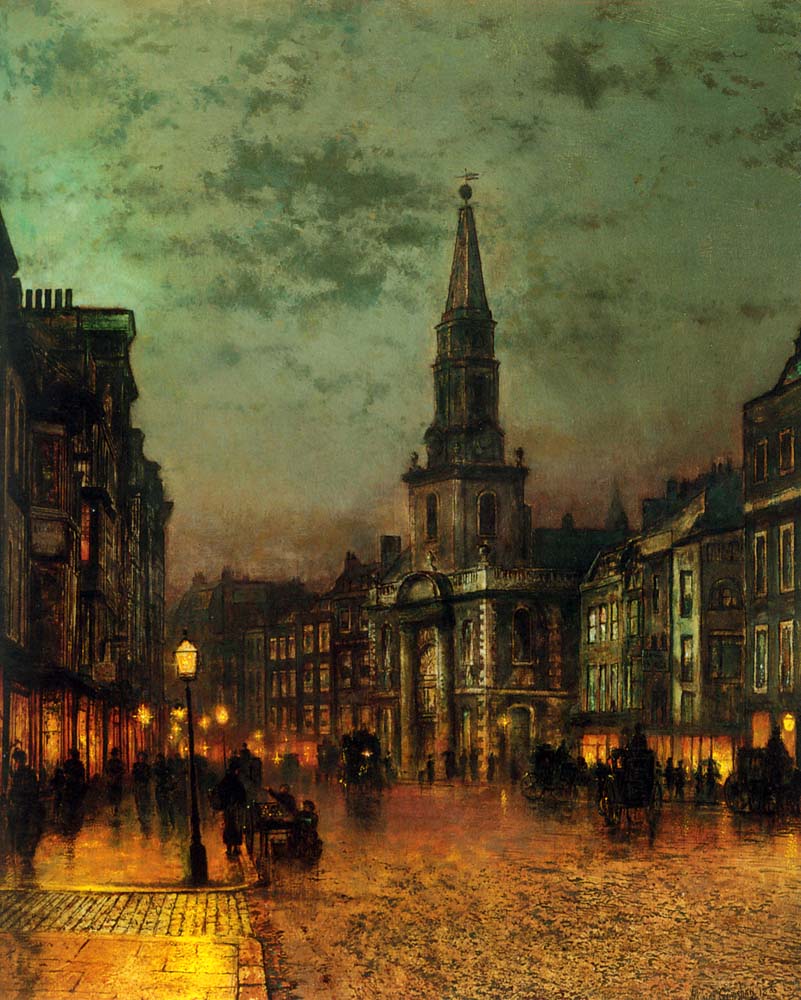
Blackman Street, London - John Atkinson Grimshaw, c.1885


        In addressing the question of why rapid population growth in early Victorian Britain didn't produce greater social upheaval, one must first address the problems such a question raises in providing a comprehensive narrative. For instance, one must first define what is meant by social upheaval, a term which generally holds connotations of violence, tension, the shift of class barriers, or the movement of a large group of people between such barriers. In such a context one can hardly ignore the fact that there was already great social upheaval during and surrounding this period, which is reflected, sometimes grimly, through such mass movements as Chartism in the mid-century; such protests as the Swing Riots of the 1830's; The Battle of Peterloo in 1819; suffragist movements of the late century, and other movements such as The Luddites, or general themes of temperance, self-governance and moral code that run throughout the period.
In addressing this question it is perhaps necessary to put forward the theory that these movements and protests could be viewed as forming part of a wider narrative of the effects of  industrialisation and urbanisation that can be seen in other events, such as the rise of 'the London mob' in the 18th century, where the number of people bound by recognizance to appear at the Middlesex Quarter Sessions on charges of rioting 'increased 520 percent between the 1660s and the early 1720s'. Other protests such as the Gordon Riots in 1780, whilst 'sprinkled doubtless here and there with honest zealots', are viewed to have been used as vessels by people ostensibly protesting against the Papist Acts who wished in actuality to vent frustration at the dire economic situation and push for political reforms in abolishing the property threshold. This notably holds strong links with the political frustration and "gut reaction to hunger and to the disorganisation caused in traditional industries by the early experience of industrialisation" of the Chartist movement of the mid-nineteenth century, which sort to gain representation for an ever growing section of the population.

The reason I feel it necessary to advance this theory is to give a feeling of a wider reaching social upheaval caused by the influx of people into cities and a push from below to identify oneself as a class both culturally and through political representation. The context of the Eighteenth century serves to show that social upheaval is an ongoing process, reflected there, but also in later feminist movements, and in Socialism in the 1930s, which Orwell saw as the only way towards 'righting the conditions' he saw in the slums and destitute poverty of northern mining and industrial towns that grew in the time period we must address. The second reason for giving such a lengthy consideration of context, is to justify looking at social upheaval through the anchoring point of population growth in the first half of the Nineteenth century. For the context clarifies the focus of the question as being not so concerned with why the population growth was limited in producing social upheaval, but rather why population growth didn't act as a catalyst to vastly increase the level of already existent and ongoing social upheaval of the wider Industrial Era. 

Of course, to address the effects of this population growth on social upheaval suitably, one must look also at the later-half of the century, to allow time for a population influx to have its effects, and for those effects to be gauged in an appropriate time frame. 

It is also worth citing Peter Clarke, in saying that any analysis of 'British' history invariably conscripts 'all Britons into the pageant of English history'. We haven't the time in this appraisal to go into in-depth analysis of the differing situations of, for example, England and Ireland; where the Great Famine of 1845 caused mass emigration and a converse decline in population, as to examine this in antithesis to the original assumption of growth is not practically feasible.

The rapid population growth of the first half of the Nineteenth century is axiomatically linked with industrialisation and urbanisation. Between 1781 and 1851 the population of England surged from just over seven million to just under seventeen million. The population of industrial towns such as Bradford, Manchester, and Sheffield tripled, and by 1851 'slightly more than half the English lived in towns', compared with less than a third in 1801.  The rise in population was met, or indeed in cases perhaps encouraged, by the expansion of Britain's economy as a whole. By 1810 the national income had more than doubled from twenty years previous. Throughout the century the 'vibrant entrepreneurial culture' of figures such as Chamberlain, Cadbury, and Salt had dramatically improved the lives of many workers within certain areas, and a surge in overseas markets due to Britain's 'colonial acquisitions and a vibrant Atlantic trade' had helped create much employment and revenue in the production of textiles, pig-iron, and coal, amongst other industries, to meet the sudden influx in population growth.

Whilst incidents such as the Lancashire Cotton Famine in the 1860s, or the Peterloo Massacre of 1819 are social upheavals due in part to dire economic conditions created in turn by the American Civil War, and the aftereffects of the Napoleonic War, it could be said that the reason population growth didn't fuel greater unrest is because of the divisions between class, counties, and north & south, which defeated a general nation wide class consciousness, and limited protests to within a region, thus making it easier for the government to suppress protests with force, as in Peterloo, and for protesters to be appeased by temporary short term acts of charity such as the distribution of blankets, or food, to affected areas. It was not until the late Victorian period that such private charity began to be 'recognized [sic] as inadequate in view of the scale of poverty',  in the face of Booth's investigation and the 'discovery of poverty'. But for the Victorian in poverty, in the face of growing population and in reference to these acts of charity, I feel it is worth quoting Orwell's dictum that; 'they [the working classes] are being compensated, in part, by cheap luxuries which mitigate the surface of life', which can be translated into a Victorian context as a general observation that shows how the increased tension of population growth is counter-balanced by, for example, falling wheat prices after 1820, or the increased availability of meat to lower income families in the 1880s.

Seen in the context of the early Nineteenth century and population growth, Orwell's dictum must also be considered alongside the fear of revolution which was spreading through Europe from 1848, and the government's stringent reaction to uprisings, as symbolised in Peterloo. It is possible that the reason a surge in population did not fuel violent class protest and clashes, thus creating greater social upheaval, is because, in the context of Britain's rapid industrialisation, urbanisation, and population growth, class consciousness was undeveloped, and that in general, protests that weren't reactionary to immediate economic circumstances, where concerned not with changing class barriers or redefining social definitions, but with a crisis of self-identity and establishing the barriers in the first place. 

Blake refers to 'the mind-forg'd manacles' of class in painting a picture of the lower classes as self-imposing their own imprisonment. And to an extent this was true. Whilst Blake, as a poet, though perhaps indicative of the ignorance of his time towards poverty and unemployment as blameless, may not examine the uncontrollable economic situations which may prevent a man from rising above his position, it is perhaps notable that the Chartist movements were movements split drastically over the morality and practically of using force, and were not as concerned with revolution or social upheaval as with finding a voice and representation for a class that was quickly growing as a result of the surge in population.

Just as the divisions between the industrious north and the artisan south may have prevented the development of a nationwide protest movement, so it is possible that the divisions within class, and the ambiguous boundaries between class prevent any strong form of class consciousness developing out of population growth that may have produced greater social upheaval. It is important to remember that the Victorian Era was not just marked by the growth of the working class, but also of the middle class, and in this context it is possible to suggest that social upheaval was not greater in its extent because rather than the established proletariat coming up against the arrogance of the aristocracy or monarchy, it was instead a growing working class seeking to establish itself against a middling class unsure of its allegiances. Orwell commented that 'in any revolt the leaders would tend to be the people who could pronounce their aitches', and it is true that many of the personalities and figures of Chartism were articulate, socially mobile men, just as they were in Socialism, though both movements could be said to have lacked support from the literary and artistic intelligentsia so crucial to the French Revolution.

Austin's Eyre is a beautiful work of Victorian social commentary that represents the ambiguity of class, in that Eyre is a well-educated girl, and yet still a powerless servant of little social standing; though perhaps the most telling analogy comes in Eyre's hatred of class discrimination, yet aversion to the uneducated pupils of Morton as 'of flesh and blood as good as the scions of gentlest genealogy'. In writing 'Jane Eyre', Brontë was addressing the placement of women within society, but in a wider sense she addresses a middle class society affected massively by population growth, that, instead of influencing social upheaval, seeks instead to establish a social order within which to define itself. 

Charles Booth attempted throughout the 1890s to classify the growing population  into strict scientific groups, whilst defining the criteria of these groups with subjective, religiously informed, moralistic language such as 'decent men… bringing up their children respectably'. This reflects a wider Victorian ambiguity to class distinction not so much based on economic standing as on social birth-right, which creates again the same sense of disunity in establishing a sense of class consciousness, or class collectiveness, on the nation-wide scale necessary to implement greater social upheaval within the context of a growing population.

The religious morality and contradictions of Victorian Britain had great effect in limiting the social upheaval of population growth within the time. The role of reforms and appeasements such as under Gladstone, Disraeli's reform act of 1867, and of institutions such as local government in 1888 did much to meet the demands of agitative social movements, such as Chartism, albeit after its collapse, and were likely influenced by the fear of revolution and the desire to appease, and yet impose a definition upon the lower classes. The early age of death of those pushed into severest poverty or hardship by unemployment and over-population possibly did much to neuter the section of society to whom more radical policies of social upheaval would have appealed. As would have the 'weak physique' of the working classes, as noted by enlisters for the Boer War. Amongst labourers the average age of death in Liverpool was as low as 15 in 1842, and the rigorous role of religion in promising 'if all do their duty, they need not fear harm', had a larger impact than is perhaps recognised in historical analysis, as opposed to social literary criticisms.

Economically, between 1870 and 1900 real wages rose by a third, and the economic boom and introduction of cheap North American wheat into the market brought commodities such as bread and meat within the price range of some working class families, helping to alleviate tensions or desire for greater social upheaval. However, during the Napoleonic wars and up until 1830 the strain on the economy and the rise in the price of bread was marked, and threatened, with a growing population, to cause mass unrest. However,  there was in this period, 'just enough increase in output to avoid a social catastrophe', and whilst some historians view the situation as having been dangerously close, most agree that major crisis was averted. The role of the expanding economy, and of commodities gained by gift of our empire and navy, in assuaging a growing population from greater social unrest is perhaps best summed up by George Orwell, and though he is speaking from a different era, he is speaking of the effects of industrialism, over-population, class identity, and urbanisation on a docile and domesticated working class, and I feel his words ring just as true for the period we are concerned with here in terms of the role of economy, culture, identity, and commodities, and again suggest the wider narrative that exists outside of this question. 

'It is quite likely that fish and chips, art-silk stockings, tinned salmon, cut-price chocolate, the movies, the radio, strong tea and the Football Pools have between them averted revolution.'

And whilst we must take into account the major issues of morality, social and cultural situations and identities of classes, I feel that this is a truer statement than most in raising awareness of the role of cheap luxuries and commodities, combined with disunity and a lack of class consciousness in averting greater social unrest in times of rapid population growth. 

I believe most class struggle within our society is not a struggle based on revolutionary motives but is a struggle of the working classes to define themselves, and of the upper classes seeking to impose a definition upon them. The middle classes, so notoriously difficult to define, both fuel this struggle, and act as a breakwater of ambiguity to increased violence. Movements seek representation in order to establish a working class voice, and are met with reforms that seek to encourage and impose, to assuage and suppress. 

Class struggle and the 'discovery of poverty' seem to have their first vocalisation in Victorian Britain, but it seems to be for each new generation to eternally struggle and discover for themselves.