|
| Siegfried Sassoon |
You smug-faced crowds with kindling eye
Who cheer when soldier lads march by,
Sneak home and pray you'll never know
The hell where youth and laughter go.
In any essay dealing with a change to society caused by a significant event, care must be taken in appreciating the subjectivity of perceived changes, long term and short term trends surrounding the event, and the difficulties of reaching a satisfactory definition of 'society'. This essay will look at both internal changes to British society in terms of shifting class boundaries through the distribution of economic and political power, and also external changes to a society through its views, self-definition, and the role of empire.
 |
Benjamin Disraeli - The UK's only Prime Minister
to date born into a Jewish family. |
In defining society it is best to judge changes on both an international and a domestic level. On an international level, British society within this period is clearly defined by its empire and its imperial outlook.
Disraeli had set out in 1867 to popularise empire and place it at the heart of British politics, and the necessity and maintenance of empire became a ground on which Conservatives and Fabians alike could 'find common cause'. By the 1890s 'intellectual and popular tastes had converged' under the cross-party cross-class issue of national imperialism, and even if this were a mere semblance of unity, in reaching an encompassing external definition of British society, judging any fundamental changes to that society by any fundamental changes within it of its views towards empire is both convenient and apt.
Imperialism gained a fervent popular tinge after the Abyssinian campaign of 1867 that can be seen bubbling to the surface in public sentiments towards the 1874 Ashanti Campaign, the calls for sharp reprisals towards the Egyptian crisis of 1882, right up to popular support for the Boer War of 1899-1902. And though one should not ignore Pro-Boer groups within British society, one should also not forget the terms useage as a politically tarring slur. Dickens, a highly regarded and publicly popular author of the nineteenth-century, perhaps reflected the growing opinion of society in 1853 when he wrote that a savage was something 'highly desirable to be civilised off the face of the earth', which reflects much of his society's imperialistic outlook.
However, there is an argument that this imperialistic view of British society underwent a fundamental change after the First World War. Britain's war debts, and inability to reclaim the $11.1m (equivalent) it had lent out to support its allies, knocked international confidence in the gold standard, and Britain was forced off it in 1919. British industry struggled to recover markets lost to rival US and Japanese competitors during the war, causing slumps in industry in the 1920s which were acutely felt by the general society, and the general rise of agitation in India and the dependant territories all equated to an 'atmosphere of failure' which severely knocked British society's self-confidence.
 |
Rudyard Kipling used to sign many of his
books with the Indian religious symbol
'the swastika', leading many people with
no sense of chronology to deride him as
a nazi-sympathiser. |
The reverence of society for military leaders such as Kitchener, 'the victor of Omdurman and the Boer War', who in this sense can be seen to reflect a form of imperialist militarism, was fundamentally changed by the horrors and diabolical leadership of the war; which is reflected in most WW1 poetry post-1917, as in Kipling's epitaph, 'If any question why we died,/Tell them, because our fathers lied.', or Sassoon's ridiculing caricature of 'fierce bold... scarlet majors'.
The 'atmosphere of failure', coupled with this rejection of the imperialist militarism, which had 'produced the war', suggests that the First World War and its consequences constitute a fundamental change within British society in its outlook, self-confidence, and views towards empire.
However, the Boer War is commonly cited as representing the accumulative 'final bout of popular imperial fervour', and that the First World War simply finished off society's interest in imperialism would imply that its decline forms a part of a longer-term shift that culminated in the first World War, meaning the roots of this fundamental change would precede the war, and hence not be attributable to it.
Also, whilst the effectiveness of propaganda upon society is debatable, it is evident that the 'imperialists were propagandizing [sic]' increasingly from c.1890 onwards with the establishment of imperialistically orientated groups such as the Imperial Federation League in 1884, the League of the Empire in 1901, and the Overseas Club in 1910, amongst others. This imposition of empire survived the war and manifested itself in propaganda in the cinemas and other forms that influenced society, such as the Wembley Exhibition of 1924-5, Empire Day, and the survival of the 'new history and geography' taught in schools which emphasised empire and its heroes. The fact that at the outbreak of the Second World War, Orwell was still arguing that imperialism needed to be separated from nationalism suggests its continued role in society's collective consciousness after 1918.
Based on this evidence, and looking at British society as being externally defined by its imperialistic outlook pre-1914, one may draw the conclusion that if the First World War did fundamentally change society, it was, in this sense, a temporary change, that was rekindled as Britain recovered and reasserted itself on the international stage. After an 'inevitable period of post-war instability', Britain's empire was again relatively stable by 1922, Britain returned to the Gold Standard in 1925, and, whilst domestic markets still suffered, Britain's international position with regards to empire was perhaps stable enough again for its society to revert back to its pre-1914 imperial self-identity.
However, if there is something to be said for the First World War's long term effect upon this element of British society, it would be that perhaps by 1920s, with inter-war depression taking its hold, society now realised that Britain was dependent on its empire for resources and man-power in order to avoid absolute dependence on the growing power of the USA. The fundamental change is evident in the shift of perceptions towards empire as an indispensable crutch, which would explain the government's increased investment in imperial propaganda, as increasingly the 'empire and society began to need each other', and away from Dickens' Orientalist, superior view of the empire needing civilising.
 |
Men Whose Fate is Linked with Coal and Cotton - Kurt Hutton, 1939.
The grandeur of the Empire seems a world away from the unemployment of Wigan. Orwell saw both, and knew which one Britain was on the road to. |
Having looked at the effect of the First World War in changing British society in terms of its international, external definition by attitudes towards empire, the remainder of this essay will examine the effects of the First World War at a domestic and internal level, as defined by society's attitude towards itself, and the distribution of economic and political power between the classes.
One of the most obvious changes to British society brought about by the First World War was the increased prominence of working and middle class women within industry, and the political and economic leverage that created. When the call for volunteers went up in 1914, the Foreign Office was overwhelmed by the sudden rush to enlist from manual labours, clearly drawn by the promise of a guaranteed wage and a better diet; and at its peak the armed forces contained 'one in three of the entire male labour force'. Initially resistant to conscription, the Liberal government were increasingly pushed towards it initially not by a need for troops, but by a need to introduce some measure with which they could limit the amount of volunteers signing up, whose presence on the western front would produce a deficit in essential industry.
The answer to this deficit however, lay in women. The amount of women in metal and chemical trades rose from 200,000 in 1914 to 'nearly a million by the Armistice', mostly from the working classes, but with spill overs from the middle classes. This in the long term however, did not cause a redistribution of power or fundamental change; women still did not hold the vote and by 1921 the female work force had virtually seen no net change from its 1911 level.
 |
Photos such as this became popular sights, but in cases such as these the allure was more one of novelty
than of an acceptance of the new role of women in British society. Women over 30 may have won the vote
when the war ended, but it was a further decade until women were granted equal voting rights. |
The First World War had created a temporary fundamental change in the constructs of British society, but it had been purposefully reverted back again at its conclusion, as promised under the Treasury Agreements. However, women now played an increased role in Labour and trade unions, whose position was strengthened by labour shortages, with trade union membership peaking at 8 million in 1919-20. Whilst trade union membership had been rising since before the war, and promises for electoral reform had been made before August in 1914, it was the war itself that brought about the calls that led to the 1918 reform bill. Whereas before, Conservative politicians had held reservations as to enfranchising the proletariat, they now held no reservations in enfranchising 'our soldier lads', and this sudden influx in the amount of enfranchised males, with the working classes in its broadest definition comprising 80% of the population, Labour now firmly established itself in Opposition.
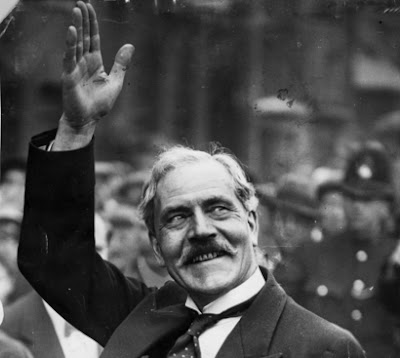 |
Ramsay Macdonald - Britain's first Labour PM, though not for very
long first time round. |
This suggests a change in the political structure of society that, whilst not radical, can be seen in the general election of 1918 to signal the imminent rise of Labour, and the decline of the Liberal party in what has been termed, 'the strange death of Liberal England', and further suggests the rising political prominence of working class concerns within society, as reflected in the work of writers and journalists such as Orwell.
In conclusion, as a whole, perhaps the war did not fundamentally change British society. Imperialism survived the war, but was now more defensive in nature than expansive, and whilst this does reflect the changing views of society, it cannot, I think, be termed a 'fundamental change', as the theme remained important and still informed politics and culture alike. However, Britain was now plagued with debts and un-reclaimable loans as a result of the war which would hamper plans for wide spread social welfare reform for another forty years. This, coupled with the emergence of the USA as a new 'economic empire', perhaps spoke of a longer term fundamental change in the way British society perceived itself on the world stage that found its causes in the First World War.
Issues on a more domestic level within society; such as women's suffrage movements, growth of the trade unions and of labour; had already been on the rise before 1914, but after the war grew exponentially in membership, or gained more widespread support. The war served to erode craft elitism in trade unions due to severe labour shortages in specialised trades, causing a fundamental shift in society towards a more united and encompassing trade union network which served to bring the working classes a much increased political leverage in settling trade disputes.
As to whether or not this constituted a fundamental change in British society depends upon how much weight one would place upon the First World War's ability to radically alter perceptions, views and ideologies. And whilst its role in this is evident (one need only think of the changing sentiments and optimism of the War's poetry, or of the resurrection of Socialist movements), one cannot dismiss that a lot of the themes, perceptions, and ideologies that define post-WW1 society were simply continuations, diminutions, or amplifications of pre-existing movements, and of pre-existing trends.